

History
New Democrats are a new political party but we build on the work of leaders from previous generations.
Origins
The origins of our movement are in the Distributist movement that emerged from the writings of Pope Leo's "Rerum Novarum" (1891) as he sought to promote social justice in the midst of class conflict arising from the industrial revolution of the 19th century.'
Writers like GK Chesterton and Hillaire Belloc developed these principles in the early 20th century to promote a decentralised approach to politics and economics that would empower all workers directly as property owners. The purpose was to distribute productive economic assets to as many people as possible.
They were critical of both unregulated Capitalism and State Socialism.
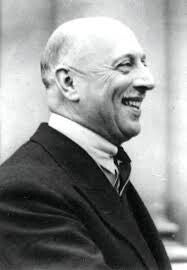
In the 1920s a British engineer named Clifford Hugh Douglas developed his theory of Social Credit. In essence he noticed during his accounting work at various British factories in different parts of the world that the costs being generated through each cycle of production were greater than the purchasing power being distributed in that same production cycle.
He considered that this "gap" in purchasing power was being filled by export revenues and bank credit. These promoted debt and forced competition for a positive balance of trade between nations - eventually leading to conflict and war as various imperial powers competed for economic profits. Douglas's books discussed his solutions for these problems. https://www.douglassocialcredit.com/
Our predecessor, the New Zealand Social Credit movement emerged from this.
Monetary reform in New Zealand
In New Zealand Monetary reform has been at the heart of our movement for many years.
Development of modern banking has resulted in nations losing the power to issue most of their own money. The present economic system, world wide, is based on debt, issued by private banks. This confers immense power on the elite few who create money and control it, and causes harm for workers, families, businesses and nations. Its effects are extreme in some situations, resulting in poverty, homelessness, unemployment, environmental harm and sickness.
The first noteworthy proponent of monetary reform in New Zealand was H. M. Rushworth, Country Party MP for the Bay of Islands from 1928 to 1938. In the House he proposed that credit and the monetary system should be controlled by the people through the Government; that a gap existed between purchasing power and production costs; that the gap could be bridged by the issue of credit; and that Parliamentary party control should not be unduly rigid.
In 1935 the first Labour government, under Michael Joseph Savage, campaigned for monetary reform. Labour used the newly nationalised Reserve Bank to fund the building of 40,000 state houses through the State Advances Corporation and to provide low interest overdrafts for the dairy board and other producer boards, but it didn't last. British banking interests threatened the Labour government advising them to borrow instead from British banks or else valuable lending to NZ in British pounds might be curtailed. Prime Minister Michael J Savage died in 1940 and Housing Minister John A Lee was sidelined and eventually expelled from the Labour Party.
In 1966 Kerikeri accountant, Vernon Cracknell, won the Hobson seat in Northland.
In 1981 under charismatic leader Bruce Beetham, who had won the Rangitikei seat in a by-election in 1977, the party gained its highest ever vote - 20.65% of all votes cast, but won only two seats under the "first past the post" electoral system. https://www.socialcredit.org.nz/
In many ways Social Credit was ahead of its time. The NZ Democrats (formerly Social Credit) advocated policies that were ahead of their time - proportional voting in 1972 (enacted 1993); an anti-nuclear New Zealand in 1978 (enacted 1987). It published "You and Your Environment", a 28 page document about protecting the environment, recycling, etc in 1973, and "Industry and People" a 16 page document proposing new concepts for industrial organisation, and ways to provide income for workers losing jobs due to the advancement of computers and robot technology. With the rise of Artificial Intelligence such policies are needed now more than ever.
Monetary reform has moved from being a minority movement to the mainstream. It is now being promoted in New Zealand and internationally by economists, professors of economics and economic commentators. You can read more about that at https://positivemoney.org.nz/
Members of Parliament
-
H M Rushworth (1928-38)
-
Vernon Cracknell (1966–1969)
-
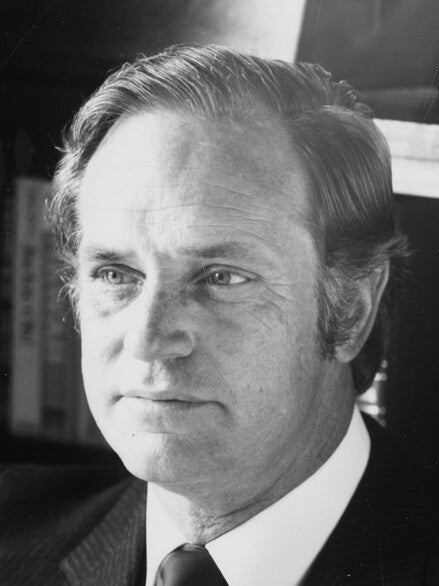
Bruce Beetham (1978–1984) (pictured right)
-
Gary Knapp (1980–1987)
-
Neil Morrison (1984–1987)
The party spent some years in the Alliance during the 1990s and then left to re-establish its own identity as Social Credit. After the death of Leader, Chris Leitch in 2023 the Social Credit Party voluntarily deregistered in 2023. But its supporters continued to make the case for monetary reform.
In 2026 the New Democratic Party of NZ takes up the cause again. Our policies have been modernised and updated for the 21st century but the reforming focus on people before super-profits, a fair go for all, care for the environment and affordable home ownership remains.

Monetary reform today
After the Global Financial Crisis of 2008 central banks used their credit creation powers to inject much needed purchasing power into the economy through Quantitative Easing (QE). They had to admit that, as Social Credit had been saying for more than 50 years that most money is created by private banks, formerly through bookkeeping entries and more recently through a few computer key strokes. https://www.bankofengland.co.uk/-/media/boe/files/quarterly-bulletin/2014/money-creation-in-the-modern-economy
The bank's incentive is to make as many profitable loans as they can and charge maximum interest on mortgages etc. The resulting asset bubble destablized the global financial system and left many jobless and homeless. Home ownership has declined massively.
Create Your Own Website With Webador